
Divestiture transactions made up 25.9% of total US M&A activity in Q3 2025, the highest share since Q3 2024, according to Deloitte. Corporates are also using divestitures deliberately, not as a last resort: PwC’s 2025 Global M&A Industry Trends report identifies the refining of corporate portfolios, including the divestment of non-core or low-growth assets, as one of the trends it expects to see more of.
A carve-out and divestiture data room is a secure repository that supports this kind of transaction and operates differently from the data room you would build for a standard acquisition.
This guide explains what a divestiture data room is, why carve-out and divestiture data rooms demand more structure than typical M&A data rooms, and how to build and manage one from the seller’s side. Buy-side teams evaluating a carved-out asset will also find the checklist and structure sections useful, since they define what a well-prepared room should contain.
Key Takeaways
- A carve-out and divestiture data room is a seller-managed virtual data room designed to support the sale of a business unit while protecting confidential parent-company information.
- Unlike a standard M&A data room, it requires strict transaction perimeter controls, standalone carve-out financials, transition-planning documents, and staged access for multiple bidder groups.
- Preparing carve-out financials, TSA schedules, and document structures before buyers begin due diligence helps accelerate the transaction and reduce avoidable delays.
- A well-organized divestiture data room should combine granular permissions, bidder-specific access, detailed audit trails, and a clear folder structure to support secure, efficient deal execution.
What Is a Divestiture Data Room?
A divestiture data room is a secure, structured virtual repository that a selling company uses to organize and share confidential information about the asset being sold with prospective buyers and advisors. It supports every stage of the transaction, from early management presentations through final due diligence and closing.
The distinction between a data room for an M&A standard acquisition and one built for a carve-out comes down to who controls it and what the hardest problem actually is.
- In a typical sale, the target company usually already exists as a clean legal entity, so the data room mainly needs to answer the “what do we show the buyer?” question.
- In a divestiture, the parent company builds the data room around a business unit that has never operated on its own, which means the harder question is “what do we rigorously keep out?” Confidential parent-company information, unrelated business lines, and data tied to entities outside the transaction perimeter must be excluded, not just organized.
This makes the seller’s document review process the center of gravity for the whole data room build, rather than the buyer’s request list.
Common Carve-Out Strategies
Companies choose between a few carve-out strategies depending on what they want to achieve:
- In a straight sale, the parent company sells the business unit outright to a strategic or private equity buyer for cash.
- In a spin-off, the parent distributes shares of the new company directly to its existing shareholders, creating an independent public entity without any cash changing hands.
- In an equity carve-out, the parent conducts an initial public offering of a minority stake in the business unit while retaining a majority stake, preserving the option to divest the remaining stake later.
Whichever route is used, buyers and sellers both look for the same thing at close: a new company with a debt-free balance sheet and a clear standalone cost structure. This matters to both the parent company and the buyer, since a clean starting position simplifies valuation and speeds up execution. A favorable funding environment tends to broaden the range of available carve-out strategies, since easier access to acquisition financing or IPO capital gives boards more room to choose the structure that best fits their goals rather than the one dictated by market conditions.
Why Carve-Out and Divestiture Data Rooms Are Different
Carve-out and divestiture data rooms are structurally more demanding than standard M&A data rooms for three reasons. Understanding each one early saves weeks of rework once the room is live.
- Boundary management. The data room must reflect the exact legal perimeter of the deal, not the informal structure of the business unit being sold. Shared contracts, commingled intellectual property, and allocated corporate overheads all sit on the boundary between the parent company and the carved-out entity, so someone has to assess each one, decide which side it belongs on, and in many cases draft a carve-out-specific version of the document from scratch. This is manual, judgment-heavy work, and it has to happen before a single buyer sees the room.
- Parallel document production. Sellers are running two processes at once. Externally, they are populating the room and responding to buyer questions. Internally, they are still producing the very documents the data room depends on, including carve-out financials, TSA schedules, and stranded cost analyses that simply don’t exist until the separation planning is underway. A standard M&A deal draws on the target’s existing records. A carve-out deal often builds the target’s financial identity in real time, alongside the sale.
- Bidder siloing at scale. Competitive auctions with several bidder groups require strict information barriers to prevent any bidder from seeing another bidder’s questions, access history, or negotiation posture. This isn’t unique to carve-outs, but the stakes are higher because a leak in a carve-out process can expose confidential parent company information that reaches well beyond what any single bidder is entitled to see.
The table below summarizes how these differences play out in practice.
| Dimension | Standard M&A data room | Carve-out and divestiture data room |
| Who builds it | Target company, often with existing clean records | Parent company, assembling records for an entity that never operated standalone |
| Core challenge | What to include | What to include and, just as critically, what to exclude |
| Financial documents | Existing audited statements | Newly built carve-out financials, stranded cost schedules, and EBITDA bridges |
| Unique document types | Standard corporate and financial records | TSA schedules, novation lists, and perimeter definition agreements |
| Timeline pressure | Single external process | External sale process running in parallel with internal separation planning |
Why Divestitures Are Growing in 2026
Corporate divestiture activity is accelerating as a deliberate strategy rather than a defensive move, and the data backs this up from several directions:
- Carve-outs now account for almost one in every three deals worldwide, outpacing the wider M&A market, according to KPMG’s carve-out research.
- Half of the 700 senior M&A decision-makers surveyed for KPMG’s 2026 Global M&A Outlook expect moderate to significant growth in carve-out activity over the next 12 to 24 months, with only 6% expecting a decline.
- PwC’s 2025 Global M&A Industry Trends report points to large corporates separating themselves from non-core businesses through spin-offs or sales, in sectors including industrials, consumer health, and entertainment.
- EY-Parthenon’s Deal Barometer forecasts continued US deal volume growth for transactions over $100 million into 2026, with nearly half of US CEOs surveyed planning divestments specifically to release capital, reduce complexity, and sharpen strategic focus.
Rising costs of capital and investor pressure to simplify sprawling portfolios are pushing corporate boards to treat carve-outs as a normal part of corporate strategy, not an emergency measure. Private equity firms are active buyers in this environment, too, acquiring subsidiaries and business units at valuations that reflect their real standalone potential.
In this climate, sellers who prepare their data room and their carve-out financials early tend to close faster and defend their deal value more effectively, because buyers spend less time chasing missing information and more time evaluating the asset itself.
What to Include in a Carve-Out and Divestiture Data Room
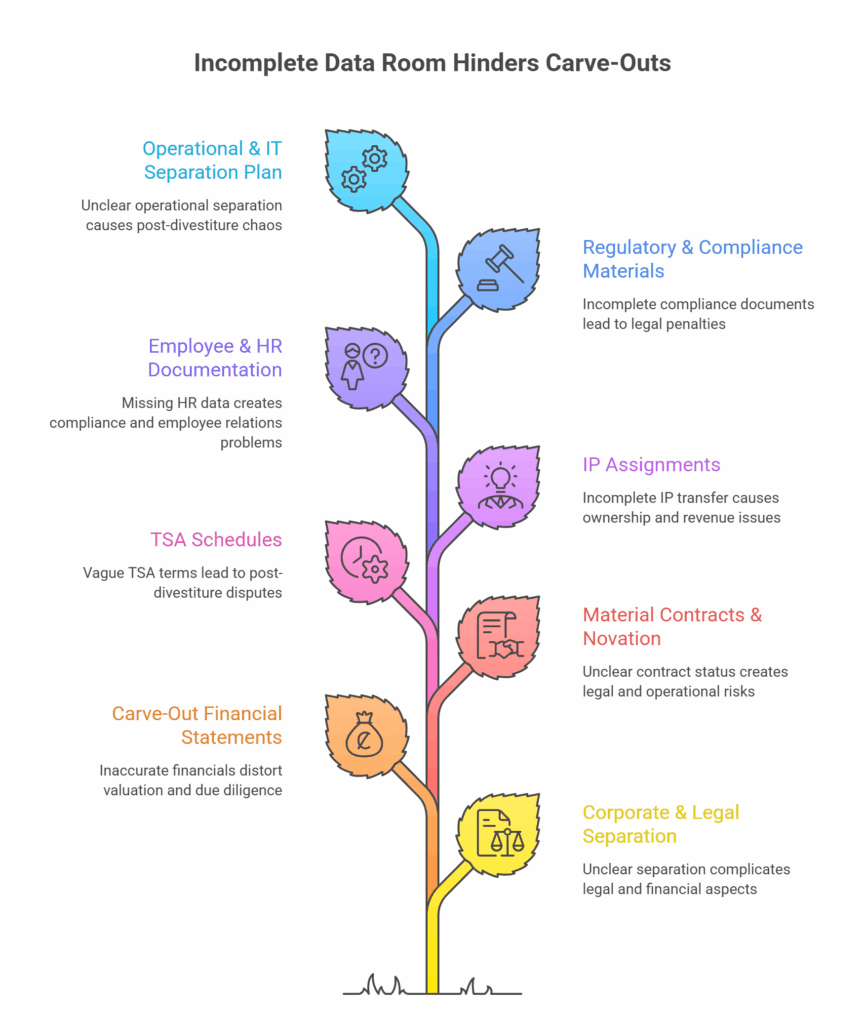
Building a complete carve-out data room means preparing document categories that a standard M&A data room simply doesn’t need. Here is what sell-side teams should have ready.
Corporate & Legal Separation Documents
- New entity incorporation documents for the standalone company or new subsidiary
- Board resolutions authorizing the divestiture
- Perimeter definition agreements setting out exactly what is and isn’t included in the sale
- Shareholder approvals, particularly where existing shareholders must sign off on the separation
Carve-Out Financial Statements
- Standalone and combined carve-out financials, covering income statement, balance sheet, and cash flow
- Stranded costs schedules identifying overhead that remains with the parent after the sale
- One-time separation cost estimates
- A management-adjusted EBITDA bridge that reconciles reported and standalone figures
Material Contracts & Novation Schedule
- Customer and supplier contracts being transferred to the carved-out business
- Contracts requiring third-party consent or formal novation
- IP licenses tied to the transferred business
- Retained agreements that will still bind both entities after the close
Transition Services Agreement (TSA) Schedules
- Proposed transition services terms broken out by function: IT, HR, finance, legal, facilities
- Pricing and duration for each service line
- Exit milestones marking when the carved-out company takes over each function independently
Intellectual Property Assignments
- IP being transferred versus IP the parent retains
- Pending assignments from employees and contractors tied to the divested unit
- Shared IP requiring a licensing arrangement rather than an outright transfer
Employee & HR Documentation
- Workforce allocation schedules mapping employees to the parent or the divested entity
- WARN Act compliance documentation for US-based workforce changes
- Key employee retention agreements
- Benefit plan transition details for employees moving to the new entity
Regulatory & Compliance Materials
- Antitrust filings relevant to the transaction
- Industry-specific license transfers
- Environmental compliance records tied to the divested assets
- Regulatory approvals required specifically because of the separation
Operational & IT Separation Plan
- Systems being transferred versus systems being carved out or rebuilt
- Data migration plan and timeline
- Cybersecurity separation milestones
- Day 1 readiness checklist confirming the standalone company can operate independently at close
How to Structure and Manage a Carve-Out Data Room
Getting the structure right up front avoids the scramble that occurs when buyers start asking for documents that don’t yet exist.
Here are a few recommendations to help you maintain well-run carve-out processes inside a data room:
- Populate in phases. Prepare core corporate, legal, and historical financial materials before any buyer NDA is signed. Hold carve-out-specific financials and TSA drafts until shortlisted bidders reach the indicative bid stage, since these documents are most likely to remain in flux early on.
- Mirror the document categories in your folder structure. A folder tree that matches the categories above (legal, financials, contracts, TSA, IP, HR, regulatory, operations) makes the room self-explanatory for buyer teams and reduces the volume of Q&A.
- Set permission tiers by bidder stage. Management presentation materials are intended for a broad audience. Indicative bid access opens the core data room. Final bid access adds carve-out financials and TSA terms. Exclusivity unlocks everything, including the most sensitive schedules.
- Enforce versioning discipline. TSA drafts and carve-out financials get restated multiple times during a live process. Every version needs a clear timestamp and a record of which bidder group saw which version, so nobody negotiates against outdated numbers.
- Freeze the index before the first NDA. Once the initial document set is locked and buyers start signing, changes should be made through controlled, logged releases rather than ad hoc uploads. This keeps the audit trail clean and makes it easy to prove exactly what each bidder group had access to and when.
A project management team coordinating legal, finance, HR, and IT workstreams should jointly own this schedule, since a carve-out data room only stays organized if every function updates it on the same cadence.
Top Carve-Out and Divestiture Data Rooms

Overall rating:
4.9/5
Excellent

Overall rating:
4.8/5
Excellent

Overall rating:
4.7/5
Excellent
Managing a Carve-Out Data Room
Carve-out transactions ask more of a virtual data room than a standard deal does, mainly because of the three structural pressures already covered: tighter control over document boundaries, two workstreams running at once, and bidder siloing that must hold up over a longer, messier timeline. Ideals VDR helps to handle each of these requirements directly by offering the following features:
- Granular document permissions. Eight levels of access control let administrators lock down individual files or folders, which matters when a single deal has parent-company records, carve-out-specific financials, and bidder-restricted TSA drafts all living in the same data room at different levels of sensitivity.
- Dynamic watermarking and fence view. These add an extra layer of protection for the kind of sensitive cost data and financial separation that should never leave the platform in an unmarked, untraceable form.
- Structured Q&A workflow. Sell-side teams get a controlled channel for managing the volume of bidder questions generated by a carve-out due diligence process, while keeping each bidder group’s questions and answers separate from every other group’s.
- Detailed audit logs. Every view, download, and permission change is recorded, supporting the kind of defensible, evidence-backed process a board wants to see when a carve-out transaction is being run competitively.
- Multi-project management and IP or domain restrictions. These help sellers keep the external sales process and internal separation planning cleanly separated within one platform, so a VDR for carve-out deals doesn’t turn into a patchwork of spreadsheets and email threads.
Common Mistakes in Carve-Out Data Room Preparation
Sell-side teams tend to repeat the same errors when preparing a carve-out data room, and each one is avoidable with earlier planning. Here are the most common mistakes:
- Populating the room with parent-company documents that inadvertently disclose confidential information outside the transaction perimeter, simply because nobody reviewed a shared folder closely enough before granting access.
- Failing to prepare standalone carve-out financials before opening buyer access forces mid-process delays right when momentum matters most.
- Publishing TSA drafts before internal alignment is complete, which hands buyers an early negotiating anchor before the seller has settled its own position.
- Using inconsistent document naming conventions across folders, which slows buyer review and generates avoidable Q&A traffic.
- Granting broad access to all bidders simultaneously, rather than staging releases by deal milestones, increases the risk of a confidentiality breach across a competitive field.
Potential solution: Build a document control checklist tied to each phase of the carve-out timeline and assign a single owner to review every document against the transaction perimeter before it enters the room.
Conclusion
A carve-out and divestiture data room is not a smaller version of a standard M&A data room. It has to reflect the exact legal perimeter of the deal, support two workstreams running simultaneously, and hold up under strict bidder separation throughout a process that often runs longer than a typical sale. Sellers who build this structure correctly from the start close faster, face fewer mid-process surprises, and defend their valuation more effectively than teams that treat the data room as an afterthought.
If you are preparing your next separation, a virtual data room for divestiture built around these requirements, rather than retrofitted from a standard M&A template, is worth setting up before your first buyer NDA goes out. Ideals VDR is purpose-built for exactly this kind of transaction.
FAQ
What is a divestiture data room?
A divestiture data room is a secure virtual repository that a selling company uses to share confidential information about the asset being sold with buyers and advisors.
How is a carve-out data room different from a standard M&A data room?
A carve-out data room must reflect the legal boundary of the deal, support two parallel processes (the external sale and internal separation planning), and enforce strict bidder siloing. A standard M&A data room typically operates within an existing, clean legal entity and doesn’t face the same document-boundary or parallel-workstream demands.
What documents go into a carve-out data room?
Core categories include corporate and legal separation documents, carve-out financial statements, material contracts and novation schedules, TSA schedules, IP assignments, employee and HR documentation, regulatory and compliance materials, and an operational and IT separation plan covering Day 1 readiness.
What is a transition services agreement in a divestiture?
A TSA is an agreement in which the parent company continues to provide certain services, such as IT, HR, finance, or facilities, to the divested business for a defined period after closing. It sets out pricing, duration, and exit milestones so the divested entity can build its own standalone capabilities without disruption.
What are stranded costs in a carve-out?
Stranded costs are overhead expenses that remain with the parent company after a business unit is sold, because they were previously allocated to the divested unit but don’t disappear once that unit leaves. Buyers expect carve-out financials to clearly show these costs, since they affect the true standalone cost structures of both companies.
How do you structure a carve-out data room?
Structure it in phases: populate core legal and financial materials before buyer NDAs are signed, release carve-out-specific financials and TSA drafts to shortlisted bidders only, mirror your folder structure to document categories, and set permission tiers that expand as bidders move from management presentation to exclusivity.
Related posts
14 August 2026
Carve-Out and Divestiture Data Rooms: A Complete Guide for Sell-Side Deal Teams
Divestiture transactions made up 25.9% of total US M&A activity in Q3 2025, the highest share since Q3 2024, according...

30 June 2026
Data Room Q&A: How to Manage Due Diligence Questions Efficiently
When buyers start digging into a deal, questions come fast. Emails pile up. Calls get missed. Someone answers a question...

12 June 2026
Best DocSend Alternatives in 2026: Top Picks
DocSend built a strong reputation as a secure document sharing platform: the kind that lets you share a pitch deck...